Fix The Budget!
Everyone's an armchair Chancellor. We built a simulator that shows why running UK finances is harder than it looks — and why citizen panels might be the answer.
The Problem Everyone Saw
"Citizens complain about government spending but don't understand budgets."
The UK is full of armchair Chancellors. Social media overflows with hot takes on NHS funding, defence spending, and why "they" can't balance the books. Yet when asked to propose alternatives, the same critics go quiet — or worse, propose arithmetic that doesn't add up.
The empathy gap is real: citizens don't feel the weight of the Red Box. They don't understand that cutting one thing affects another, that markets react to fiscal policy, and that every pound has a constituency fighting for it.
The Problem That Was Actually There
The Micro-Macro Fallacy: People apply household budget logic to sovereign finance.
The Three Delusions
1. The Household Myth
"Government should balance its books like I do." Wrong. A sovereign currency issuer isn't constrained by income the same way. The real constraint is inflation, bond market confidence, and GDP growth.
2. The Big Numbers Problem
"£100 billion deficit" means nothing to most people. It's too abstract. They can't feel it. They can't see what £1bn cut from Health looks like in their local hospital.
3. The Empathy Vacuum
Every fiscal decision has winners and losers. Cutting pensions saves money but creates poverty. Raising taxes funds services but suppresses growth. Where's the tool that shows both sides?
The Unexpected Solution
A game that makes you feel like the Chancellor.
The Red Box Experience
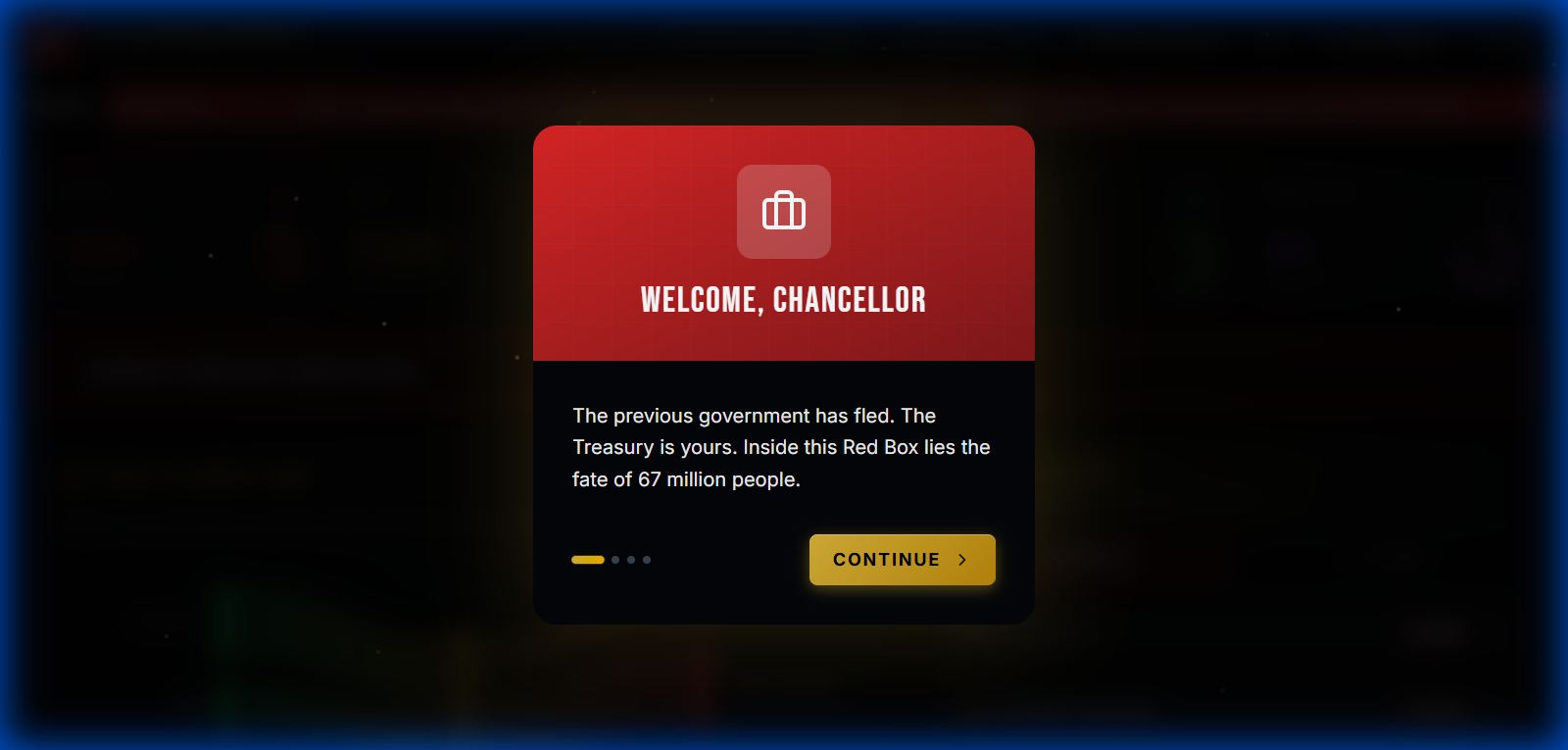
You don't start with a spreadsheet. You start with drama: "The previous government has fled. The Treasury is yours. Inside this Red Box lies the fate of 67 million people."
Real-Time Consequences
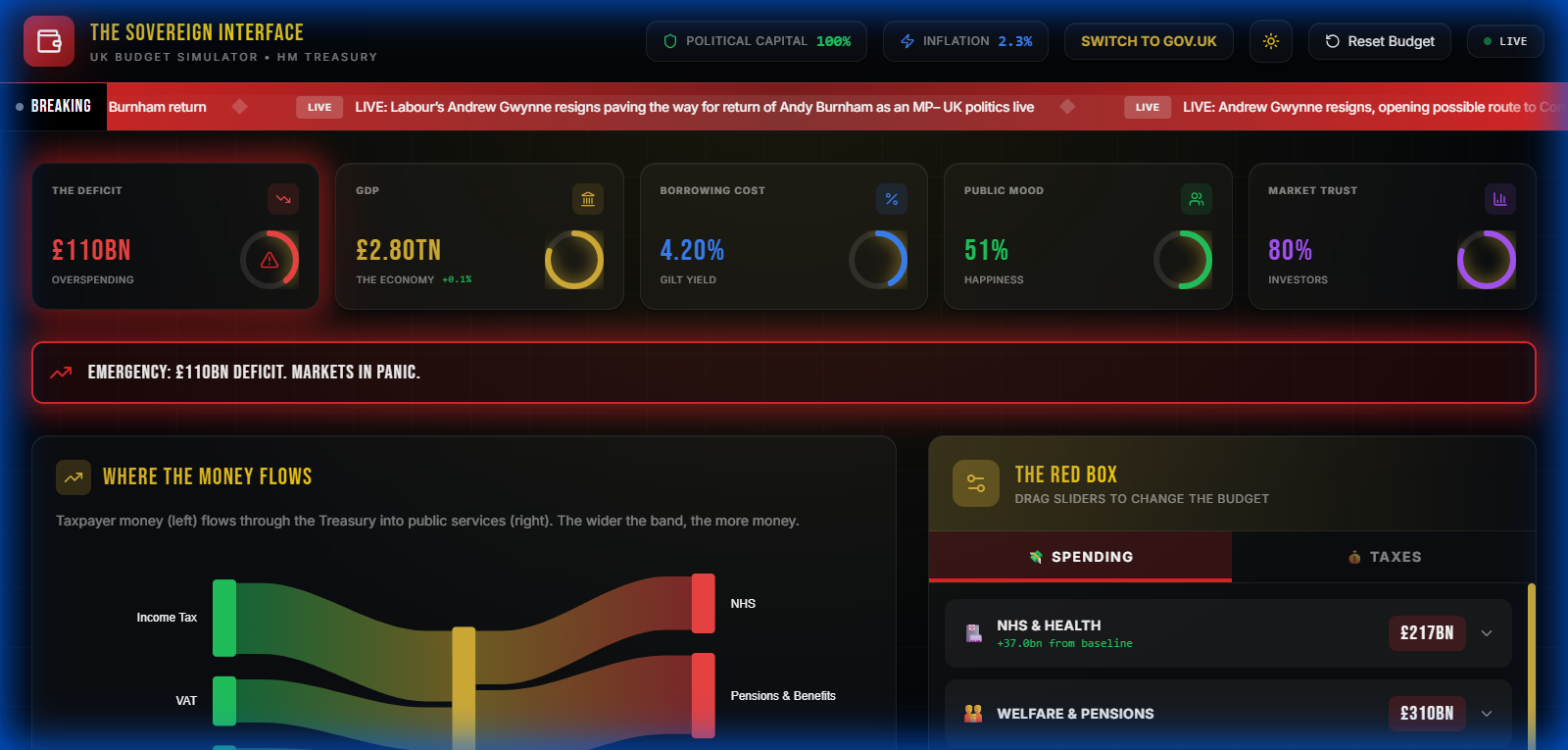
Increase NHS spending by £37bn? The ticker screams "HOSPITALS REJOICE" — but then "MARKETS IN PANIC" as your deficit spikes. The bond vigilantes are watching.
What We Built
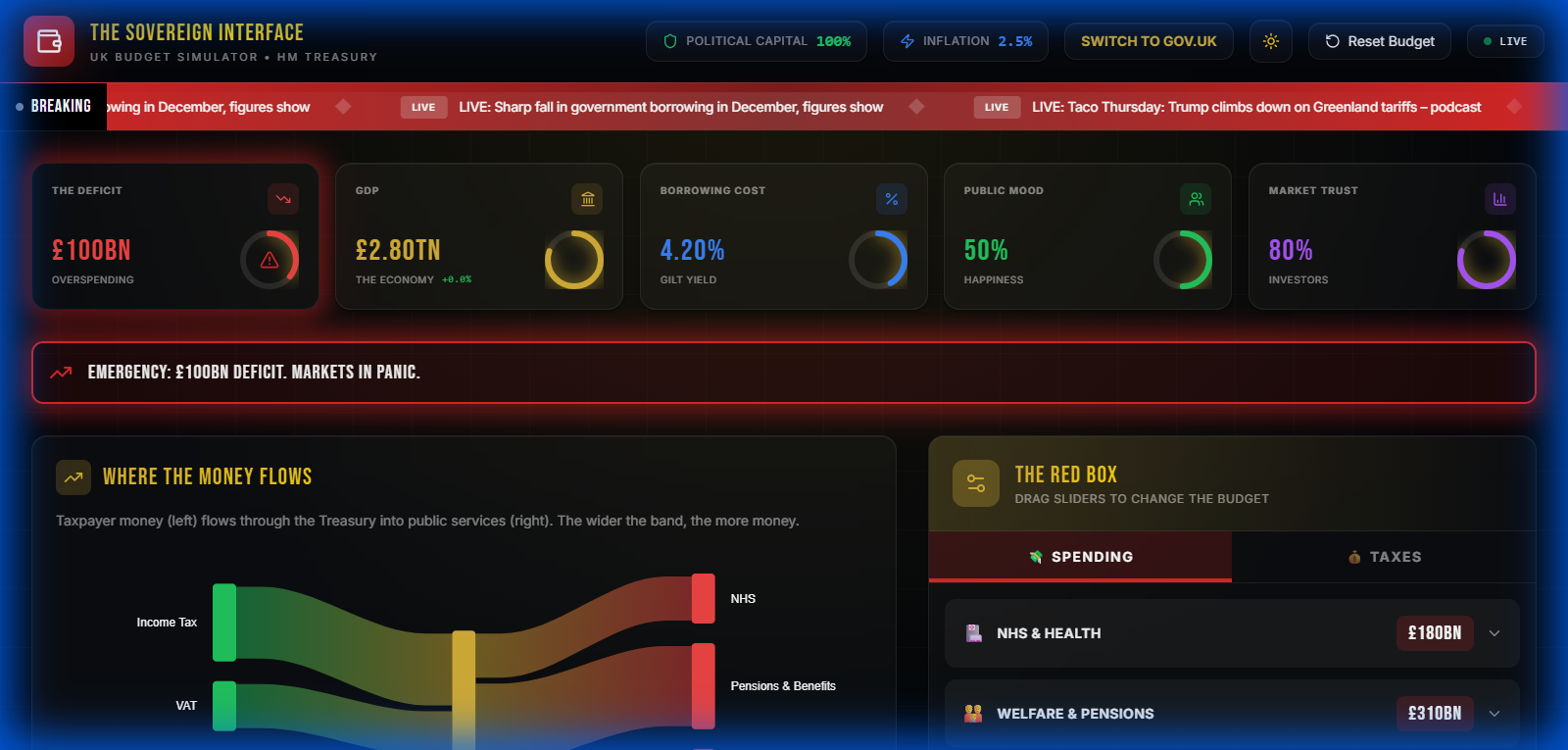
- Sankey Flow Visualisation: See exactly where the money comes from and where it goes
- Fiscal Multipliers: Cutting infrastructure hurts GDP more than cutting admin
- Laffer Curve Modelling: Raise taxes too high and revenue falls as behaviour changes
- Bond Market Vigilantes: Run a deficit too large and your borrowing costs spike
- Live News Ticker: AI-generated headlines respond to your every decision
- GOV.UK Mode: A version built to government design standards — ready for adoption
What You Can Steal
1. The "Red Box" Onboarding
Don't start with data. Start with drama. Make users feel the weight of their decisions before they touch a single slider. This applies to any complex decision tool — mortgages, investments, business strategy.
2. Empathy Algorithms
Every £1bn cut has a human translation. NHS cuts = 45,000 more on waiting lists. Youth services cuts = £4bn in future social costs. Build the empathy layer into your analytics.
3. Narrative Volatility
Budgets aren't spreadsheets — they're political events. The news ticker makes abstract decisions feel real. Consider how your internal dashboards could generate narrative feedback, not just metrics.
4. Progressive Disclosure
Level 1: Total Tax, Total Spend, Total Borrowing. Level 2: Departments. Level 3: Individual policies. Build mental models before complexity.
5. Citizen Panels as Product
What if the government let citizens "vote" with sliders? Not for policy — but to signal priorities. Like GitHub pull requests for democracy. Participation as engagement engine.
The Bigger Picture
This isn't just a budget game. It's a prototype for participatory democracy.
When I was a journalist, I hosted community news conferences where readers shaped our editorial agenda. The organisations that thrive in 2026 are the ones that bring their audience into the room — not as observers, but as participants.
The closer you get people to the core of the business, the more invested they feel — whether as citizens, customers, or colleagues.
Fix The Budget demonstrates what's possible when you treat complex systems not as black boxes to be explained, but as experiences to be felt.
Want to build something like this?
We build interactive tools that turn complexity into clarity. Budget simulators, strategy games, diagnostic dashboards — whatever helps your audience understand what you do.
Start the ConversationResources
- GitHub Repository — Full source code
- IFS Be The Chancellor — The original inspiration
- Office for Budget Responsibility — Where the real numbers come from